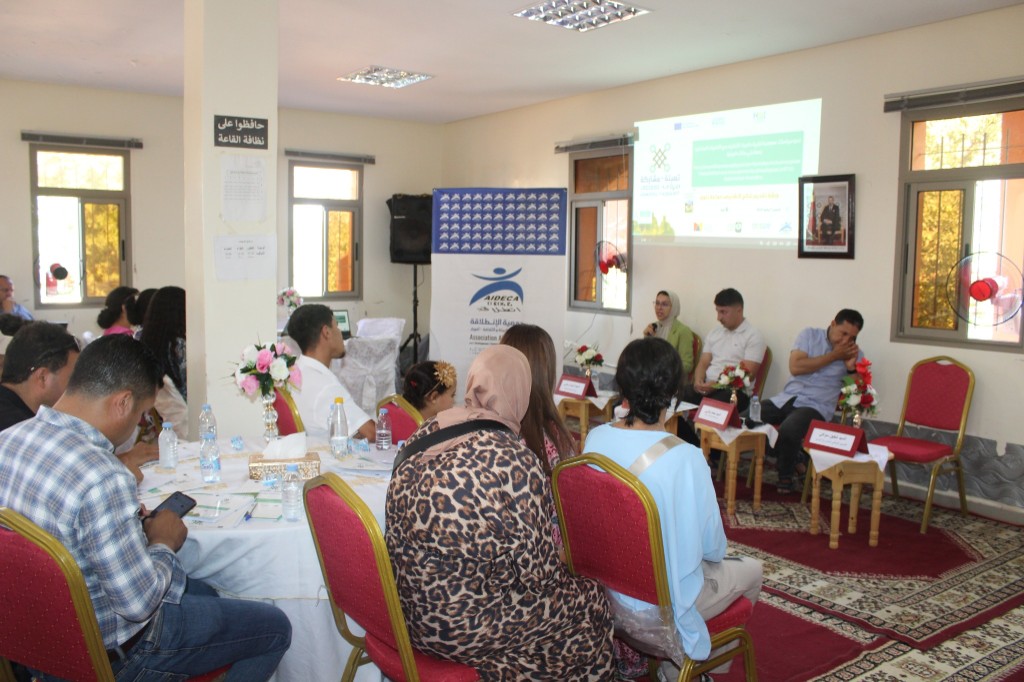
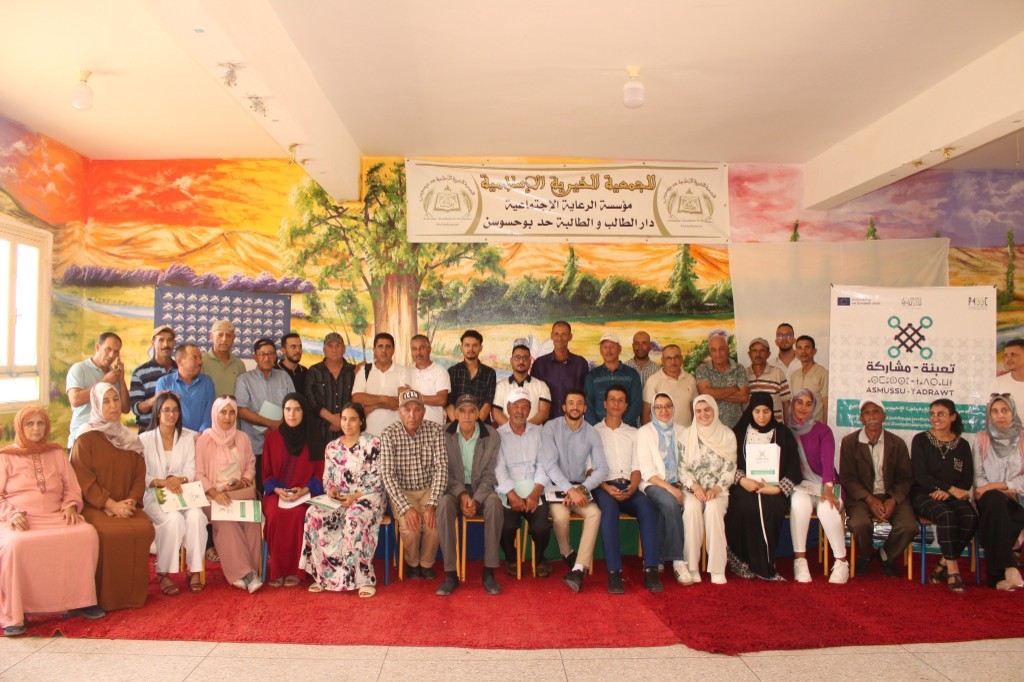
Residents, elected officials and AIDECA staff at the climate results workshop in Had Bouhssoussen

Association Al Intilaka for Development, Environment and Culture – Afourer

Annual Report 2025

A year of resilience

How AIDECA kept working with young people, women, cooperatives and communes across Béni Mellal-Khénifra after its largest programme stopped in January.

January – December 2025

Foreword

Resilience, then results

2025 opened with a shock. In January, the freeze on US foreign assistance stopped ISED-BMK, our largest programme, and in February the partnership was terminated after four years of work with civil society across the region. We closed the project responsibly and protected the continuity of our teams and commitments.

The rest of the year showed the strength of our model. In Azilal, 1,442 young people applied to the youth entrepreneurship programme we run with the INDH, and 183 projects were validated, more than twice the target. With Manos Unidas, the third edition of ASSURIF turned towards green entrepreneurship. With the AMUSSU programme, five communes mapped their climate risks with more than 640 citizens. With Ajyal Égalité, AMSSAWASS trained and mentored 40 elected women ahead of the 2026 elections.

We also strengthened our own house: a leaner team supported by interns and volunteers, and an independent evaluation of the social impact of ASSURIF since 2021. We thank every partner, commune and community that walked this road with us.

In figures

2025 in eight numbers

1,442
young people applied to the youth entrepreneurship programme in Azilal
183
youth projects validated for INDH support, against a target of 80
265
jobs in the 94 businesses still active from the 2022 and 2023 cohorts
643
citizens took part in participatory climate diagnostics in 5 communes
321
local actors set climate priorities for their Communal Action Plans
40
elected women from 13 communes completed training and mentoring
9
green businesses equipped under ASSURIF III; 26 of their 31 entrepreneurs are women
89
green business ideas and 6 priority sectors mapped across the region

Sources: project narrative reports 2025, the AEJ 2025 activity report and AIDECA 2025 data sheets.

Month by month

The year in milestones

January – March

  1. 24 Jan The US foreign aid freeze stops ISED-BMK; the partnership ends on 28 February
  2. 11 Feb Regional meeting on green entrepreneurship in Béni Mellal (105 participants)
  3. 13–16 Feb Climate bootcamp in Azilal co-creates the participatory diagnostic tool
  4. Mar Leadership bootcamp for elected women
  5. 12 Mar Women's entrepreneurship day in Azilal (76+ participants)
  6. 21 Mar Youth entrepreneurship training starts: 29 workshops by 23 April

April – June

  1. 11–13 Apr Commune representatives trained on the climate diagnostic tool in Afourer
  2. 24 Apr Regional forum on the cooperative movement in Béni Mellal
  3. 8 May 183 youth projects validated after 1,073 profiling interviews
  4. May ASSURIF pitch before a committee with ODCO, ONCA and ANAPEC
  5. 22–23 May Opportunities Forum in Azilal for 270 young people
  6. 21 Jun Afourer meeting on gender-sensitive monitoring of communal plans

October – December

  1. Oct Ajyal Égalité closing seminar in Tunis with partners from Morocco, Tunisia and Libya
  2. Oct Tax and financial education training for young entrepreneurs in Tagleft and Moulay Aissa Ben Idriss
  3. 13 Nov Climate results workshop in Hal Merbaa, the fifth commune
  4. 27 Nov AMSSAWASS closing seminar in Béni Mellal (121 participants)
  5. Nov – Dec Critical thinking workshop in El Ksiba during the 16 Days campaign
  6. 4 Dec Climate resilience of tourism session in Tabant, Aït Bouguemez
A young woman presents her business project during the ASSURIF pitch

Axis 1

Socio-economic inclusion of young people and women

From an idea to a business: training, equipment and follow-up that open jobs and income to young people and women, including in rural areas.

1,442
young applicants
183
projects validated
9
green businesses equipped

INDH Programme III

Youth Entrepreneurship Support (AEJ), Azilal

AIDECA runs the whole support pathway for young project holders in Azilal province, from the first information session to coaching after the business opens. In 2025 the pre-creation cycle reached every circle and pashalik of the province, from Ouaouizeght to Demnate.

Partners: Provincial Committee for Human Development of Azilal, under Programme III of the National Initiative for Human Development (INDH): income improvement and economic inclusion of young people. AIDECA is the implementing partner for 36 months.

National Initiative for Human Development (INDH)
Project page
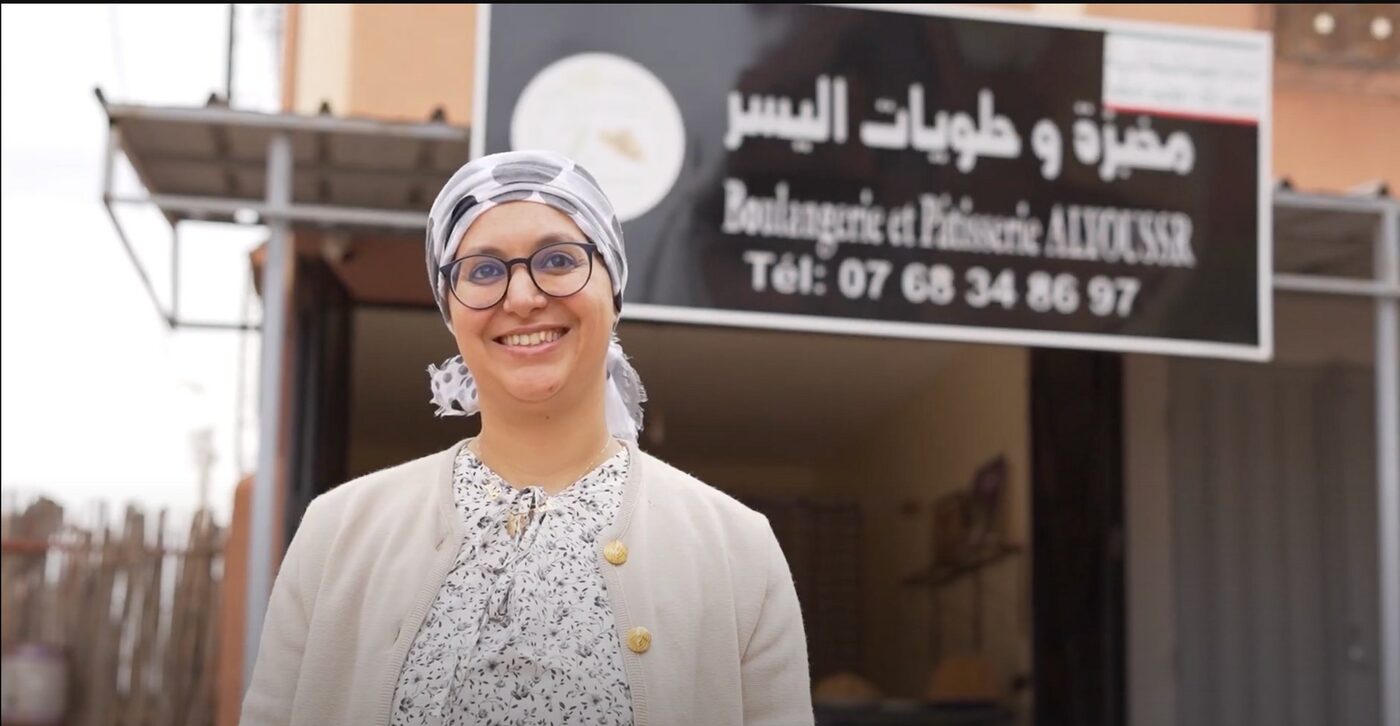
A young entrepreneur in front of her bakery and pastry shop

The 2025 pre-creation cycle

  1. 1,442 applications registered through the provincial youth platforms
  2. 1,073 profiling interviews, 24 April to 7 May
  3. 183 projects validated on 8 May for INDH post-creation support (target 80)
  4. 34 young people have already launched their activity (target 30)

Training and coaching

930
young people in 29 initiation-to-entrepreneurship workshops (116 hours) in Azilal, Imlil, Afourer and Bzou
270
young people at the Opportunities Forum, 22–23 May
860
hours of workshops and individual coaching for the 183 selected project holders

Workshops covered business plans, ideation and design thinking, the legal forms of businesses and soft skills, followed by 732 hours of individual coaching on each business plan.

Opportunities Forum, Azilal, 22–23 May

11 stands and 17 workshops on digitalisation, digital marketing, financing and support schemes, and investment in tourism, with ANAPEC, OFPPT, banks, the Provincial Delegation of Tourism, ONCA, the DPA and the regional development company Atlas Tourisme BMK.

Nine institutions sat on the selection committee (CPDE)

  • Division of Social Action
  • Provincial Directorate of Agriculture
  • Provincial Directorate of Crafts
  • Social Development Agency
  • Provincial Delegation of Tourism
  • ANAPEC
  • OFPPT
  • ONSSA
  • Provincial Council of Azilal

After creation: the 2022 and 2023 cohorts

AIDECA kept following the businesses created in earlier cycles, from equipment purchase and tripartite agreements to field visits and coaching.

106
businesses followed through 106 field visits
94
still active; 7 more awaiting equipment
265
jobs generated
42
post-creation workshops since 2023 (252 hours)

Topics: financial education, tax, soft skills, business development, digitalisation with an introduction to AI tools, marketing and sales.

What we learned

  • Close, personalised coaching makes the difference: young people followed regularly presented stronger, more viable projects.
  • Distance limits attendance in remote rural areas, so online modules and closer field follow-up come next.
  • Post-creation follow-up must become a permanent part of the scheme to keep businesses alive.

Access to finance

From coaching to Intilaka financing

Many young project holders in Azilal and across the region look for funding through Intilaka (Damane Intelak), the national programme that eases access to bank credit for young businesses. AIDECA does not lend or decide on credit: it prepares entrepreneurs so they reach the bank with a solid file.

  1. Diagnostic and orientation

    A first conversation to place the idea or activity, the profile of the project holder and the local market, and to point to the right scheme: INDH support, an honour loan or a bank loan under Intilaka.

  2. Training sessions

    Group workshops on business plans, ideation and design thinking, the legal forms of businesses and soft skills: 860 hours in 2025 for project holders in Azilal province.

  3. One-to-one coaching and the file

    An adviser works with each project holder on the business plan, forecasts and financing plan, and on gathering the quotes and documents the bank asks for.

  4. After financing

    Follow-up once the business opens: training on financial education, tax, marketing and digitalisation, and field visits to consolidate the activity.

In 2025 the Opportunities Forum in Azilal brought banks, ANAPEC, OFPPT and support institutions together with 270 young people, including orientation sessions on financing and support schemes.

Manos Unidas · Dec 2024 – Sep 2025

ASSURIF/ⴰⵙⵓⵔⵉⴼ III: green entrepreneurship for vulnerable women and youth

Building on the editions launched since 2021, the third edition of ASSURIF supports the socio-economic inclusion of women and young people in vulnerable situations, with a new focus on the green economy: lower carbon footprint and circular economy, combined with stronger local actors and better living conditions.

Partners: Manos Unidas · Provinces of Azilal, Béni Mellal and Fquih Ben Salah

Manos Unidas
Project page

Three result areas

  1. Information campaign

    Visits to the Social Action Divisions of the three provinces, ODCO, CRI, ANAPEC and the Faculty of Economics and Management of Béni Mellal; 10 awareness sessions with local associations; and short videos in Darija on Facebook, Instagram and LinkedIn.

  2. Pre- and post-creation support

    Pre-selection of 24 project ideas, personal development coaching, business plans with "green" criteria, a pitch before a committee with ODCO, ONCA and ANAPEC, equipment, and training on marketing, digitalisation, management and conflict resolution.

  3. Green entrepreneurship

    A participatory study and mapping of green entrepreneurship in Béni Mellal-Khénifra, presented to regional actors and shared with young people and women.

Support agreements were signed in Afourer on 10 July, and the closing ceremony followed on 11 July with the head of the Afourer district and representatives of ANAPEC, ODCO, ONCA and the ASSURIF network.

Results

168
participants (83 women) in 10 awareness sessions; 561 applications received online
24
project ideas accompanied; 16 business plans completed
55
people (43 women) coached in personal development
9
businesses equipped: 4 cooperatives and 5 auto-entrepreneurs
31
entrepreneurs in the funded businesses: 26 women and 1 person with a disability
59
participants (54 women) in 7 post-creation training sessions

Mapping green entrepreneurship

Launched in October 2024, the study mobilised associations, cooperatives, businesses and public institutions to map the region's green economy, identify promising sub-sectors and define the skills young people and women need.

  1. 11 Feb Regional meeting at the Faculty of Economics and Management, Béni Mellal: 105 participants (55 women), with USMS, the Regional Directorates of Crafts, Environment and Tourism, ONCA and ODCO
  2. Feb – Jul Results shared with 375 young people and women (197 women) in 7 sessions in Azilal, Khouribga, Demnate and Tagleft, and with 20,000+ people online
  3. Result 89 green business ideas and 6 priority green sectors

The funded green businesses

Eco-friendly traditional and modern clothing, sewing workshops, a tourism cooperative in El Ksiba, a bakery in Souk Sebt, traditional wooden household goods near Ouaouizeght, a solar-powered agricultural cooperative and a women's cooperative making natural herb couscous in Naour.

We started with five women; today we are seven. Thanks to the solar energy provided by the project, our costs went down and our income went up, which gives the members a stable income.
Itto Ouhmouch · President of the Ouhmouch agricultural cooperative, Douar Boulmaâden, Naour

In Douar Aït Baallal (Naour), a women's cooperative now makes 100% natural couscous with local herbs such as carob, thyme and saffron. In Béni Mellal, Sabrine El Khadim opened her own sewing workshop with ASSURIF's support and says she is now financially and personally stable.

ASSURIF 2021–2025: what an independent evaluation found

Over four cohorts, ASSURIF accompanied 81 projects and funded 27. The final evaluation surveyed 56 beneficiaries and 10 network members, with 21 interviews and 3 focus groups.

83.9%
say their project is running and growing
88.5%
report higher turnover
89.3%
created at least one job beyond their own
80.4%
call ASSURIF's support decisive
88.1%
of women report greater financial autonomy
81.0%
of women report a bigger role in household decisions

The evaluation recommends moving from creation to consolidation: stronger post-funding support, simple management tools, access to markets and public procurement, and approaches adapted to women and mountain areas.

Axis 1 · Meetings

Forums that connected entrepreneurs with institutions

Women entrepreneurs and partners at the Azilal Youth Platform on International Women's Day

12 Mar 2025 · Azilal

Women's entrepreneurship: an investment in a sustainable future

For International Women's Day, 76+ participants at the Azilal Youth Platform heard women entrepreneurs' stories and met support, employment and training institutions.

Read the article
Auditorium during the regional cooperative forum in Béni Mellal

24 Apr 2025 · Béni Mellal

Regional forum on the cooperative movement

Structuring the cooperative movement and restoring cooperative identity, with the regional delegation of ODCO and the Regional Directorate of Vocational Training.

Read the article
Young people in the audience at the Opportunities Forum in Azilal

22–23 May 2025 · Azilal

Opportunities Forum

An opportunities fair and workshops on sustainable tourism, digitalisation and financing, with the Provincial Committee for Human Development.

Read the article
Entrepreneurs and partners at the ASSURIF agreement signing in Afourer

10 Jul 2025 · Afourer

ASSURIF support agreements

Selected women's cooperatives and self-employed entrepreneurs signed their support agreements before receiving equipment and coaching.

Read the article
A field interviewer talks with a resident during the climate diagnostic in Had Bouhssoussen

Axis 2

Climate resilience

Resilience starts with listening to residents: five communes mapped their climate risks with their citizens and turned them into priorities.

643
citizens consulted
5
communes diagnosed
321
local actors

AMUSSU · Sep 2024 – May 2026

ASTA: towards inclusive territorial policies for climate change adaptation

ASTA helps communes build climate resilience into their Communal Action Plans (PAC), with the active participation of civil society, young people, women and people with disabilities.

Partners: AMUSSU programme of the Strategic Support Programme for Civil Society (PASSC), co-funded by the European Union and implemented by COSPE and Migrations & Développement, with AESVT

Co-funded by the European Union, PASSC, Migrations & Développement, COSPE, AESVT
Project page

What ASTA sets out to do

  1. Characterise

    Map climate impacts in five communes and identify actions for their PAC.

  2. Build a framework

    Give councils and their Equity, Equal Opportunities and Gender bodies (IEECAG) a working method to integrate resilience into the PAC.

  3. Strengthen knowledge

    Strengthen local actors' knowledge of climate impacts and resilience options.

  4. Share good practice

    Help communes take ownership of a shared manual of good practices.

In 2025 AIDECA and its partners finalised a participatory diagnostic tool (15 thematic maps, a questionnaire and an interview guide), trained 27 commune representatives to use it, including offline data collection with KoboToolbox, and supported the communes as they led the diagnostics. When Timoulilt withdrew, Hal Merbaa joined as the fifth commune.

Citizens consulted in each commune

  • 188 Oulad Gnaou
  • 186 Azilal
  • 167 Naour
  • 69 Hal Merbaa
  • 33 Had Bouhssoussen

643 citizens in all, through surveys, focus groups and workshops (target: 500).

Results in 2025

5
communes completed their diagnostic: Azilal, Naour, Oulad Gnaou, Had Bouhssoussen and Hal Merbaa
321
local actors in 5 workshops presenting results and setting priorities together
4
communes coached to draft advisory opinions bringing climate change into local policy

From diagnosis to action

  1. 13–16 Feb Bootcamp in Azilal co-creates the climate risk and vulnerability diagnostic tool
  2. 24 and 26 Mar Tool tested in Naour (27 participants) and Oulad Gnaou (26)
  3. 11–13 Apr Three-day training in Afourer for IEECAG members, youth councils, staff and elected officials (27)
  4. Apr – Jun Diagnostics in Azilal, Oulad Gnaou, Naour and Had Bouhssoussen
  5. 17, 18 and 24 Jul Results workshops in Naour, Azilal and Oulad Gnaou: 196 local actors
  6. 18–19 Jul Demnate workshop with the communes to build the good-practice manual
  7. 18 Sep Results workshop in Had Bouhssoussen (61 participants)
  8. Oct Four diagnostic workshops in Hal Merbaa (69 participants)
  9. 13 Nov Results workshop in Hal Merbaa (64 participants)
  10. Sep – Dec Coaching four communes on climate advisory opinions; planning a civic space for dialogue with local decision-makers

Priorities raised by the communes

  • Water stress: drip irrigation, retention basins, reuse and local water governance
  • Sustainable management of forests and biodiversity
  • Drought-resilient crops and livestock, and diversified rural incomes
  • Waste sorting at source and local recycling
  • Mountain, agro- and eco-tourism that respects the environment
  • Small solar installations for public buildings, irrigation and tourism sites

What we learned

  • Communes' main need is access to finance to turn priorities into bankable projects.
  • IEECAG members asked for incentives and targeted support on GIS and maps.
  • Offline data collection with KoboToolbox proved decisive in low-connectivity areas.

Synergy: climate resilience of tourism in Azilal

On 4 December 2025, within the Sustainable Tourism Switzerland–Morocco programme (TDSM), AIDECA co-facilitated a session on climate mitigation and adaptation for tourism in Tabant, Aït Bouguemez. Twenty-five transporters, gîte owners, guides, commune staff and students mapped the most exposed sites and identified priority actions.

ASTA also worked with AMSSAWASS and the provinces to raise awareness of communes in the Moroccan Network of Open Local Authorities. Weekly posts, commune pages and a video on the Naour diagnostic gave the process wide visibility.

Axis 2 · In the field

Diagnostics led by the communes themselves

Participants of the climate bootcamp in Azilal

13–16 Feb 2025 · Azilal

Climate bootcamp

Elected officials, commune staff and civil society co-created the participatory tool for diagnosing climate risks and vulnerability.

Read the article
Commune representatives working on maps during the training in Afourer

11–13 Apr 2025 · Afourer

A participatory tool in action

Commune representatives practised the 15 thematic maps, the questionnaire and offline data collection.

Read the article
Workshop on climate results in the commune of Naour

17 Jul 2025 · Naour

Naour presents its results

Residents and local actors discussed the diagnostic and agreed on adaptation priorities for the commune.

Read the article
Group photo of the climate results workshop in Oulad Gnaou

24 Jul 2025 · Oulad Gnaou

Oulad Gnaou sets its priorities

The commune with the largest participation, 188 citizens, turned its results into proposals for the Communal Action Plan.

Read the article
Elected women working together during a training workshop in Afourer

Axis 3

Participatory democracy, local governance and equality

Elected women who speak up in council, gender-sensitive advisory opinions, and a responsible close-out of our largest governance programme.

40
elected women trained
13
communes
5
advisory opinions

Ajyal Égalité · Jun 2024 – Nov 2025

AMSSAWASS: elected women leading for equality

AMSSAWASS strengthens the political participation and leadership of elected women in Béni Mellal-Khénifra. After the 2024 launch and a diagnostic of 23 elected women with Sultan Moulay Slimane University, 2025 was the year of training, mentoring and change inside the councils.

Partners: Ajyal Égalité programme, funded by the French Development Agency (AFD) and the French Embassy in Morocco and implemented by Expertise France

French Development Agency (AFD), French Embassy in Morocco, Expertise France
Project page

The 2025 journey

  1. Mar Bootcamp on personal development and leadership for elected women
  2. Apr – Oct Two mentoring cycles, in person and on WhatsApp: reading the communal budget, preparing council sessions, institutional communication and monitoring the PAC
  3. 21 Jun Afourer meeting on gender-sensitive monitoring of communal plans (60+ participants)
  4. Jul Five-day bootcamp for the second cohort in Demnate
  5. Sep Training on inclusive territorial planning for elected officials and IEECAG members
  6. 24 Sep Workshop with 13 communes produces a charter for fair, non-stereotyped institutional communication
  7. 27 Nov Closing seminar in Béni Mellal with 121 participants, on women's place in the 2026 elections
Second cohort of elected women at the bootcamp in DemnateElected women at the leadership bootcampElected officials at the training on inclusive territorial planning

Four strands of work

  1. Training and mentoring

    Two bootcamps and two courses on gender-sensitive planning and the theory of change for 40 elected women from 13 communes.

  2. Bringing men on board

    Two sessions for male elected officials and IEECAG members on gender-sensitive planning.

  3. Influencing local plans

    Five workshops helping IEECAG and elected women draft gender-sensitive advisory opinions for the revision of the PAC.

  4. Inclusive communication

    A charter for fair, non-stereotyped institutional communication, adopted by several communes.

Results

80+
elected women reached in 13 communes
40
completed training and mentoring
5
gender-sensitive advisory opinions
121
participants at the closing seminar
  • Several elected women spoke or tabled proposals in their council for the first time.
  • One charter on inclusive communication adopted by several communes.
  • A booklet, "Elected Women, Champions of Equality", records their journeys and good practices.

What we learned

  • Flexible scheduling is essential to fit elected women's family and professional commitments.
  • Involving male elected officials is key to shared, lasting ownership of gender equality.
  • Post-training follow-up should help women turn new skills into local initiatives.

USAID / FHI 360 · Aug 2021 – Feb 2025

ISED-BMK: an early close

Inclusive Socio-Economic Development in Béni Mellal-Khénifra

In January 2025 AIDECA was supporting six local associations to file petitions and access-to-information requests with their communes. On 24 January, following the US Executive Order on the review of foreign aid, FHI 360 instructed AIDECA to stop all work, and on 28 February the subaward was terminated.

  • The project team went from four full-time staff to one person for the close-out, and all documentation was archived.
  • The network of associations, the tools and the participatory mechanisms built with the project now feed AIDECA's governance work, notably ASTA and AMSSAWASS.

What the project left behind (2021–2025)

133
associations trained on participatory mechanisms, access to information and advocacy
76
youth leaders, who mobilised 991 young people around local public policies
1st
regional forum on participatory democracy in Béni Mellal-Khénifra, co-organised in 2023
Project page
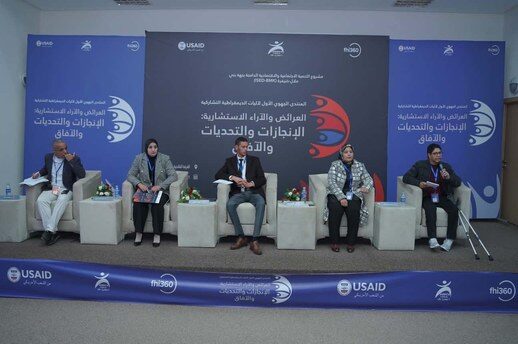
Speakers on stage at a regional ISED-BMK forum

Beyond the region

  1. Oct 2025 · TunisClosing and capitalisation seminar of the Ajyal Égalité programme, with partners from Morocco, Tunisia and Libya

Axis 4

Education, culture and digital inclusion

Critical thinking for young people, digital skills for young entrepreneurs, and a training centre open to the whole region.

Critical Thinking School

Run since 2024 with the association En Toutes Lettres and supported by the French Development Agency, the school trains young people of the region to question, argue and debate. During the 2025 16 Days of Activism campaign, graduates of its second edition led an introductory workshop for young people of the Second Chance School in El Ksiba, with the Forsa association.

Digital skills for young entrepreneurs

Digital tools were part of every stage of the AEJ pathway in 2025.

  • Workshops on digitalising businesses and on digital marketing at the Opportunities Forum
  • Post-creation workshops on digitalisation, with an introduction to AI tools for automation and customer management
  • Offline data collection with KoboToolbox for the climate diagnostics

The Afourer Youth Capacity Building Centre

AIDECA runs the centre with the Mohammed V Foundation for Solidarity. It is our head office and a regional venue for training and dialogue used by communes, elected women, cooperatives, associations and schools.

  • Youth entrepreneurship workshops on business plans, legal forms, soft skills and design thinking
  • The three-day climate diagnostic training for commune representatives (April)
  • Post-creation and tax training for young entrepreneurs (September)

Organisation and partnerships

The team and partners behind 2025

Programmes and partners

ProgrammePartner(s)Period
Youth Entrepreneurship Support (AEJ) INDH, Provincial Committee for Human Development, Azilal Ongoing
ASSURIF III: green entrepreneurship Manos Unidas Dec 2024 – Sep 2025
ASTA: climate adaptation in communal plans AMUSSU / PASSC (EU), COSPE, Migrations & Développement Sep 2024 – May 2026
AMSSAWASS: elected women and gender equality Ajyal Égalité: AFD, French Embassy, Expertise France Jun 2024 – Nov 2025
ISED-BMK (closed) USAID / FHI 360 Aug 2021 – Feb 2025
Climate resilience of tourism, Azilal province Sustainable Tourism Switzerland–Morocco (TDSM) Dec 2025

The team in 2025

RoleNumber
Executive coordinator1
Administrative and financial manager1
Project manager and project officers3
Administrative assistants3
Field agents2
Staff10
Interns (AEJ and ASTA)3
Volunteers (youth and women's activities)2

Governance and management

  • Responsible close-out of ISED-BMK during the stop-work period.
  • Continued rollout of the 2024–2027 strategic plan, the GESI policy and the 2024–2027 communication strategy.
  • Independent social impact evaluation of ASSURIF (2021–2025) to guide the next phase of the model.

Networks

  • Civil Coalition for the Mountain
  • National Coalition for Accountability
  • Dunia Coalition to end child marriage
  • Azilal associative development network
  • Anna Lindh Foundation network
  • Moroccan Forum for Lifelong Learning
  • Réseau ASSURIF

Lessons learned

What 2025 taught us

  1. Training, equipment and follow-up after creation, together, are what keep small businesses alive.
  2. The missing link in climate adaptation is turning priorities into bankable projects.
  3. Involving male elected officials and flexible scheduling are conditions for women's participation to progress.
  4. Measuring impact builds trust and opens the door to new partners.
  5. Close, personalised coaching produces stronger projects than training alone.

Outlook

Priorities for 2026

For 2026, AIDECA has organised its action around five interconnected strategic pillars for participatory and inclusive development:

  1. Socio-economic inclusion of young people and women
  2. Climate resilience
  3. Local governance
  4. Migration
  5. Digital inclusion in rural areas

Building on 2025

  • Complete ASTA: the good-practice manual, advisory opinions and a civic space for monitoring local climate policies
  • Move ASSURIF from business creation to consolidation, as the impact evaluation recommends
  • Keep supporting elected women and IEECAG ahead of the 2026 elections
  • Continue following the young entrepreneurs funded under AEJ

Strengthening the organisation

  • Diversify partnerships after the end of ISED-BMK
  • Strengthen post-training and post-funding follow-up systems
  • Consolidate partnerships with communes, regional institutions and media
  • Capitalise and share good practices across programmes
AIDECA representatives receive the CDG Social Impact Prize

Since then · 22 January 2026

CDG Social Impact Prize 2026

In Rabat, AIDECA received the CDG Social Impact Prize 2026, a national distinction for civil society action with vulnerable communities and for inclusive socio-economic development.

Read the article

Thank you

AIDECA thanks its partners, the communes and public institutions of Béni Mellal-Khénifra, its members, staff, interns and volunteers, and above all the young people, women, cooperatives, elected women and associations who made 2025 a year of resilience and results.

contact@intilaka.org · www.intilaka.org · 0523 44 19 92

Join Our Team

Open positions, tenders, and consulting opportunities in Morocco and beyond.

See Opportunities

Become a Partner

We collaborate with governments, NGOs, and institutions to open pathways for lasting change.

Partner With Us